
Orthopedic Urgent Care in Miami Shores: Sprains, Fractures, and Getting an Answer the Same Day
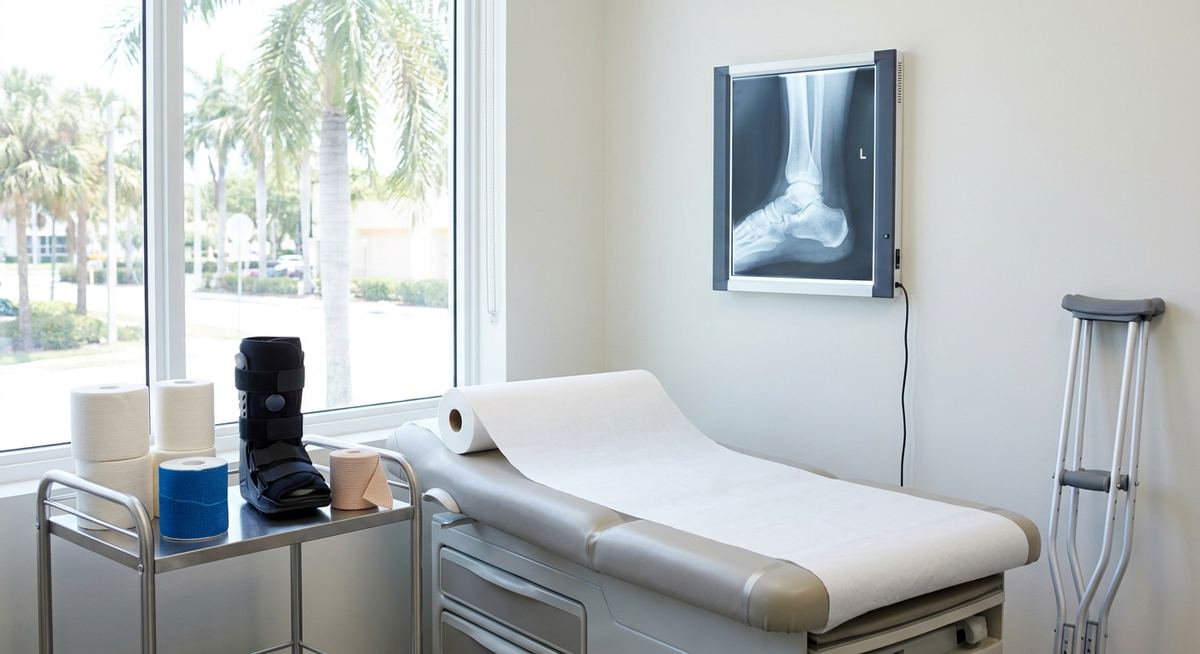
Fall sports season is underway across Miami-Dade, and with it comes the predictable wave of rolled ankles, jammed fingers, wrist injuries from a fall, and knees that felt fine on the field and swelled up by dinner. Add in the everyday version — a misstep off a curb, a fall on a wet floor during a September downpour, lifting something badly at work — and orthopedic injuries become one of the most common reasons people need care right now, today, without waiting.
The question most people face in that moment is not whether to get it looked at. It is where to go. Here is how to think about it.
The Real Problem: You Cannot Tell a Sprain From a Fracture by Feel
This is the single most useful thing to understand. A bad ankle sprain and a small fracture can present almost identically — swelling, bruising, pain with weight bearing, limited range of motion. People routinely walk around on fractures for a week assuming it is “just a sprain,” and just as routinely panic over a sprain assuming it is broken.
The distinction matters because the treatment diverges. A sprain generally needs protection, controlled loading, and progressive rehab. A fracture may need immobilization, specific positioning, or orthopedic follow-up — and some fractures, particularly in the wrist, foot, and around growth plates in children, heal badly if they are treated as soft-tissue injuries for the first two weeks.
You cannot resolve that with an internet search or by pressing on it. You need imaging.
Why On-Site X-Ray Changes the Visit
This is the difference between an urgent care that can actually handle an orthopedic injury and one that can only refer you elsewhere.
At Medi-Station, diagnostic imaging including X-ray and ultrasound is on site, which means a single visit can cover the whole sequence: examination, imaging, interpretation, and treatment. You leave knowing what is wrong and with the injury properly managed — splinted, braced, or wrapped — rather than leaving with an imaging order and an appointment for Thursday.
Our orthopedic urgent care handles the full range of what walks through the door in September: ankle and wrist injuries, suspected fractures, dislocated fingers, knee injuries, back strains, and sports injuries across all age groups.
What We Can and Cannot Treat
Being straightforward about this saves people time.
Well suited to urgent care:
- Ankle, wrist, knee, shoulder, and finger injuries with suspected sprain or simple fracture
- Splinting, bracing, casting, and crutch fitting
- Sports injuries needing same-day evaluation and clearance decisions
- Back and neck strains without neurologic symptoms
- Lacerations, minor wounds, and injuries needing stitches
- Follow-up imaging and re-evaluation
Belongs in an emergency department instead:
- Obvious deformity or bone through skin
- Loss of pulse, sensation, or color in the limb
- Suspected hip fracture, or an inability to move or bear any weight after a fall in an older adult
- Head injury with loss of consciousness, confusion, repeated vomiting, or worsening headache
- Injuries from a high-speed collision or a significant fall
- Suspected spinal injury
If you are unsure which category you are in, our guide on choosing between urgent care and the ER walks through it, and you are always welcome to call. The American Academy of Orthopaedic Surgeons also publishes accessible patient guidance on specific injuries that is worth bookmarking.
Young Athletes Need a Different Standard of Caution
Children and adolescents are not small adults, orthopedically speaking. They have open growth plates, and growth plate injuries can look mild on presentation while carrying real consequences for bone development if they are missed. A child who has pain directly over a growth plate after an injury should be imaged even when the swelling seems minor.
There is also the overuse problem, which fall season reliably produces. Pain that appears gradually — no single injury, just increasing discomfort over two or three weeks of practice — is a different pattern and often signals a stress reaction rather than an acute injury. The Centers for Disease Control and Prevention tracks sports and recreation injuries among youth as a major source of emergency visits nationally, and a large share of those are preventable with earlier evaluation and adequate rest.
Our pediatric urgent care sees these injuries daily and is set up for children in the way a general adult clinic is not.
What to Do in the First Few Hours
Before you get seen, the basics still hold and they genuinely help:
- Stop using it. Continuing to play or walk on a possible fracture is how minor injuries become significant ones.
- Ice, wrapped in cloth, 15–20 minutes at a time. Not directly on skin, not for an hour straight.
- Compress gently with an elastic wrap — snug, not tight. Numbness or color change means it is too tight.
- Elevate above heart level where possible.
- Do not “test it” by putting weight on it repeatedly to see how bad it is.
- Skip the heat in the first 48 hours. Heat increases swelling early on.
Over-the-counter pain relief is reasonable for most adults, but if there is any chance you will need a procedure, mention what you have taken and when.
Bring These With You
A visit goes faster with:
- Photo ID and insurance card, if you have one
- A list of current medications and known allergies
- The story of the injury — what happened, when, what you felt and heard
- Any prior imaging of the same body part
- For a student athlete, any school or league paperwork requiring clearance
We see patients on a walk-in basis with no appointment, and we offer a flat-rate self-pay option for patients without insurance. Details are on our know before you go page.
Work Injuries and Employer Coverage
A meaningful share of September orthopedic visits are workplace injuries — lifting, slips on wet floors, ladder falls. If your injury happened at work, tell us at check-in so it is documented correctly from the start, which protects your claim later. We work with employers through our employer services program for occupational injury care and return-to-work evaluation.
After the Visit
An orthopedic injury is rarely finished in one appointment. Depending on findings, the plan may include a recheck in seven to ten days, repeat imaging, referral to an orthopedic specialist, or physical therapy. Follow the immobilization instructions exactly — the most common reason a simple fracture heals poorly is that the patient stopped using the splint once it stopped hurting, which is usually well before the bone has healed.
Come back sooner than scheduled if pain increases rather than decreases, if swelling worsens after 48 hours, if you develop numbness or tingling, or if a cast or splint becomes wet, cracked, or uncomfortably tight.
Walk In Today — No Appointment Needed
If something is swollen, painful, and you do not know whether it is broken, you do not have to wait days to find out. We are open seven days a week with X-ray on site and a board-certified emergency medicine physician leading the clinic.
Medi-Station Urgent Care — Miami Shores, FL — Mon–Fri 9am–8pm, Sat–Sun 10am–5pm — https://www.medistationurgentcare.com